
News & Updates
Latest news, product launches, and industry insights.
October 15, 2026
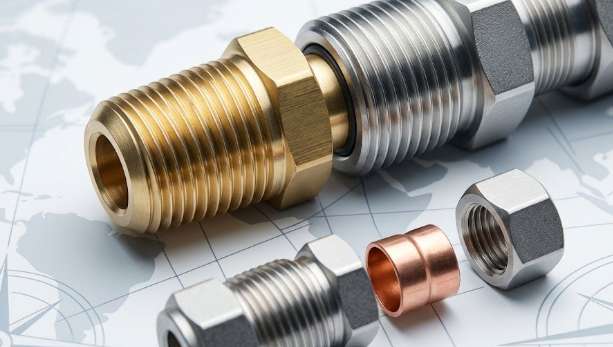
NPT, BSP, and Compression Threads: Understanding Fitting Connection Standards Globally
Read more →
October 15, 2026
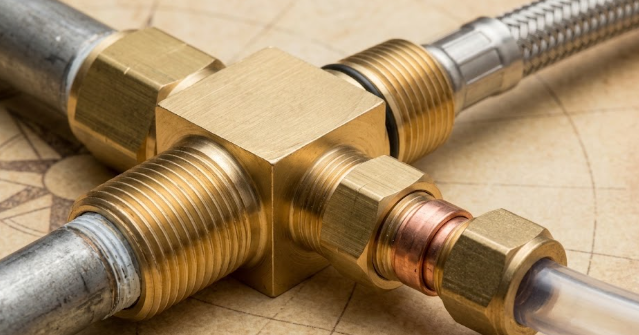
Brass, Stainless Steel, and CPVC: Material Selection Guide for Industrial Plumbing Fittings
Read more →
August 11, 2026
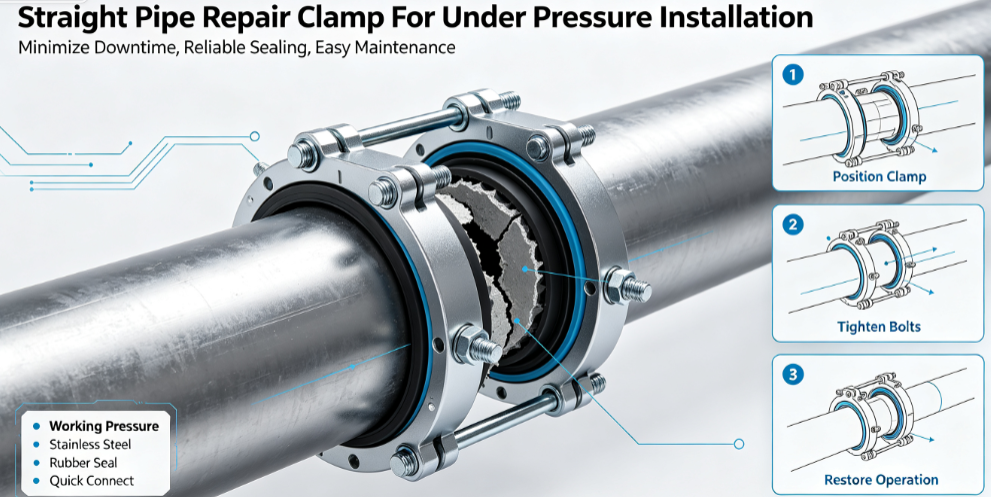
Under Pressure Quick Installation Straight Pipe Repair Clamp, No Pipeline Shutdown & Drainage Required
Read more →
August 11, 2026
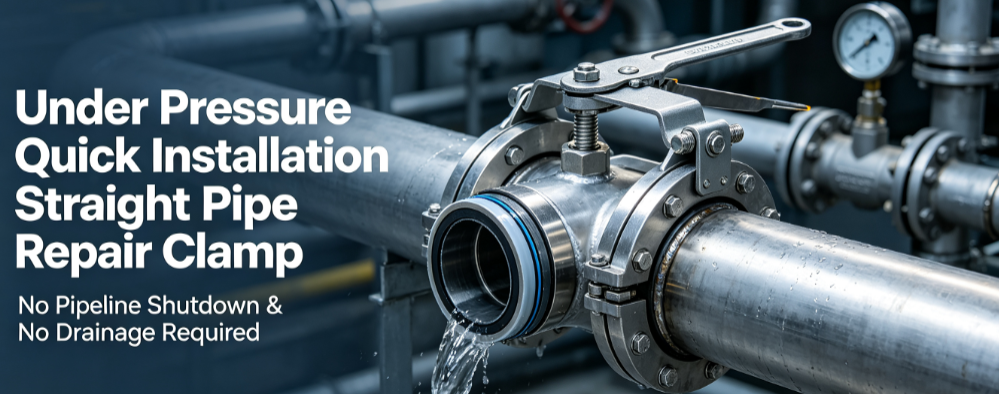
Global Market Demand Analysis of Offshore Wind Power Special Three-Way Pipeline Flange Barrel Tee Repair Clamp
Read more →
July 14, 2026
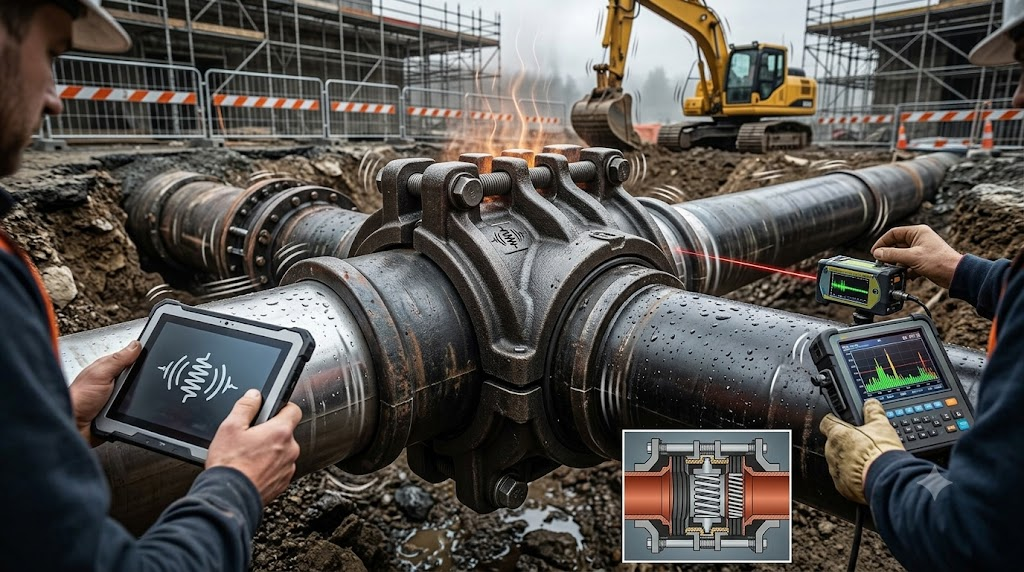
Protecting Pipelines in Seismic Zones: How Reducer Repair Clamps Double as Anti-Vibration Expansion Joints
Read more →
July 14, 2026
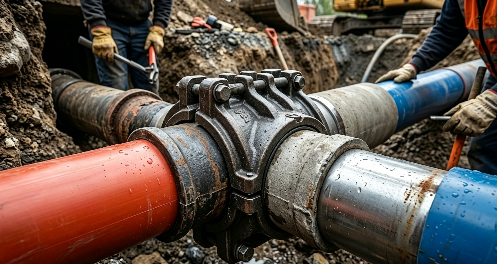
Cross-Material Pipe Repair: How Ductile Iron Clamps Seamlessly Adapt to PVC, HDPE, Steel, and Cast Iron Pipelines
Read more →
June 27, 2026
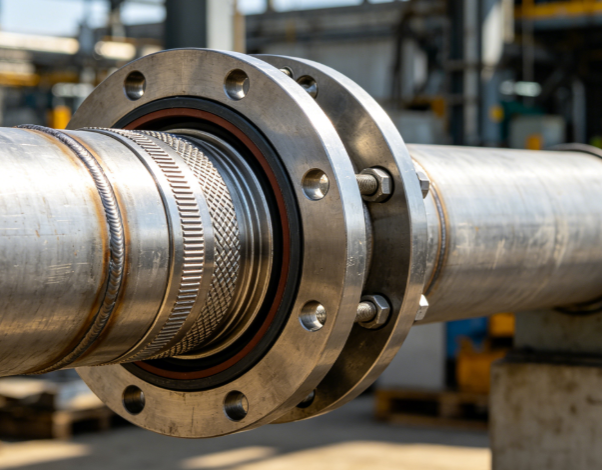
Sleeve Repair Clamp vs. Standard Couplings: Choosing the Right Fitting for Flange Obstructions
Read more →
June 27, 2026
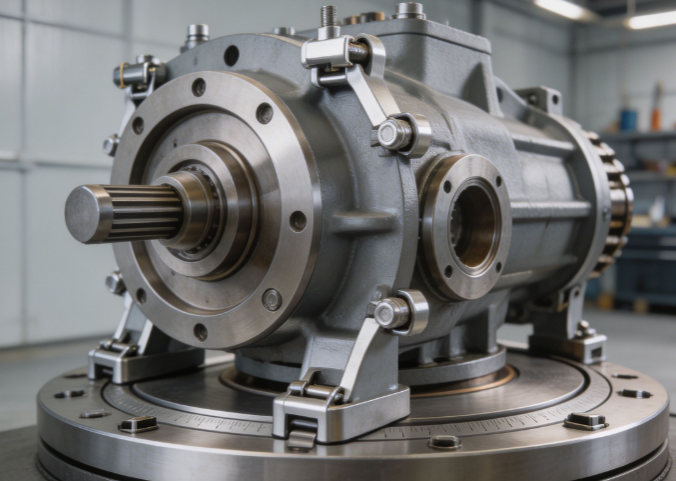
How a Gearbox Repair Fixture Improves Maintenance Efficiency
Read more →
May 16, 2026
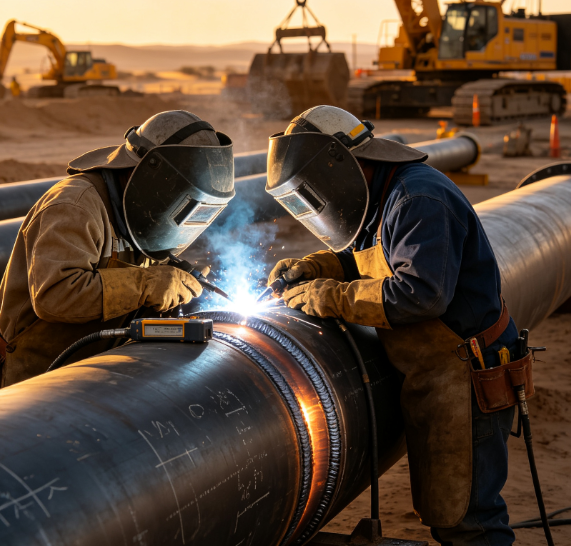
Welding vs. Clamping: Which Is Better for Pipeline Integrity?
Read more →
May 16, 2026
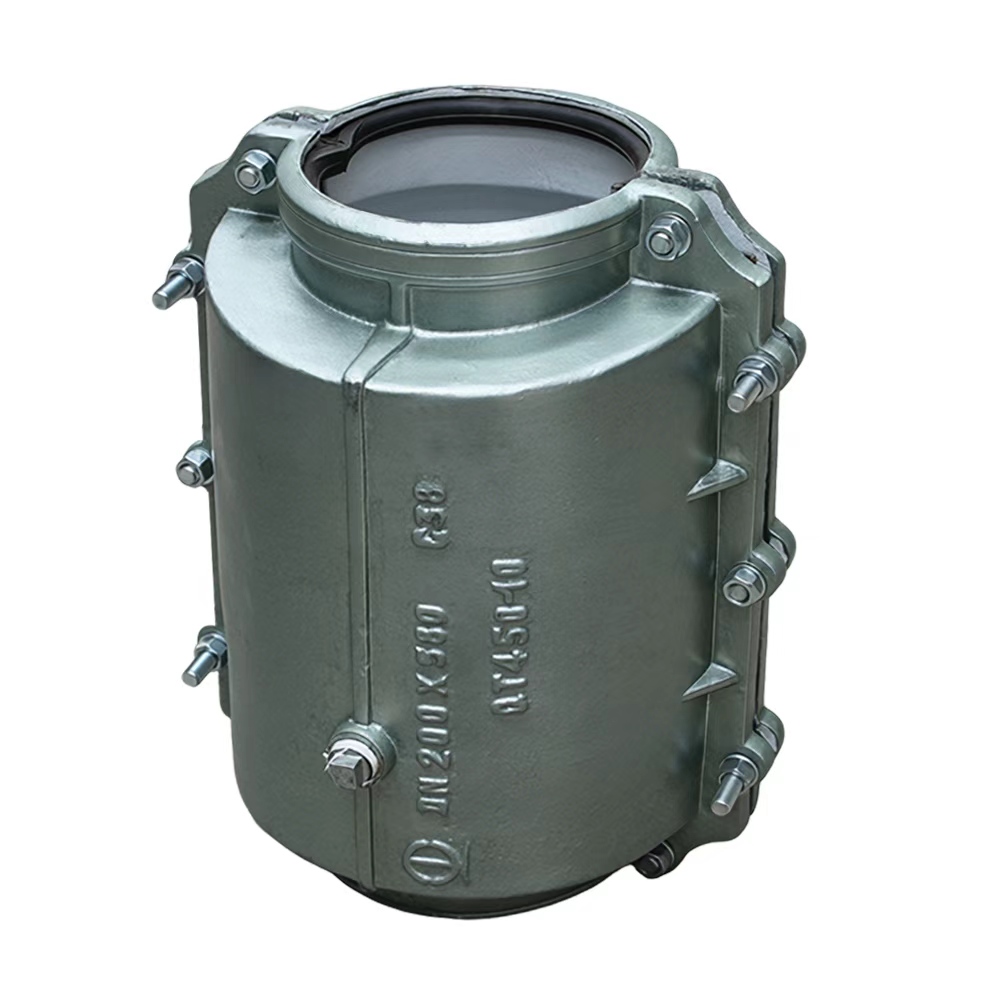
Fast Fixes for Burst Pipes: The Power of Straight Pipe Repair Clamps
Read more →
May 13, 2026
Pipe Repair Clamp vs Pipe Coupling: What’s the Difference? — An Engineer’s Guide to Not Buying the Wrong Part
*In the middle of a night-shift shutdown, the difference between a repair clamp and a pipe coupling stops being academic and starts being the difference between fixing a leak in twenty minutes versus cutting out a pipe section and shutting down the line for eight hours. Yet outside the ditch, the two get confused constantly — sometimes deliberately by field crews looking for a shortcut, sometimes by procurement teams staring at part numbers that look interchangeable on a purchase order. They are not interchangeable. This article lays out exactly what separates them: the engineering intent, the governing standards, the installation conditions where each makes sense, and the procurement traps that B2B buyers need to avoid. Table of Contents Defining the Distinction — Repair vs. Joining as Engineering Intents What a Pipe Repair Clamp Actually Is What a Pipe Coupling Actually Is The Standards That Govern Each Pressure, Temperature, and Service Life — A Quantitative Comparison Installation Conditions — When You Cannot Shut Down the Line Applications Where Confusing the Two Gets Expensive Material, Seal Design, and the Deflection Problem B2B Procurement Traps FAQ Summary and Next Steps 1. Defining the Distinction — Repair vs. Joining as Engineering Intents The most important thing to understand about a pipe repair clamp and a pipe coupling is not their geometry. It is the engineering problem each was designed to solve. A repair clamp is a remediation device. Its job is to seal a leak, reinforce a damaged section, or restore the pressure boundary of an existing pipeline that has already been put into service. It does this by wrapping around the pipe at the point of failure — typically without cutting, without welding, and often without even depressurizing the line. A pipe coupling is a joining device. Its job is to connect two distinct pipe sections — either during initial installation or when a damaged segment has been cut out and a replacement spool inserted. A coupling expects prepared pipe ends: threaded, grooved, butt-welded, or plain-end, depending on the coupling design. It does not deal with corrosion pits, cracks, or ovalized pipe; it joins clean, intact pipe ends. The distinction is not semantic. Selecting the wrong product results in failed seals, premature corrosion, regulatory non-compliance, and hazardous leaks. A repair clamp used to join two pipe ends will fail because it offers no deflection capacity. A coupling used to cover a leaking hole will not seal because it was never designed to conform to an irregular surface under system pressure. 2. What a Pipe Repair Clamp Actually Is A pipe repair clamp is a mechanical device consisting of a metal outer shell — usually stainless steel or ductile iron — and a compressible elastomeric sealing element, tightened around the circumference of the pipe by a series of bolts. The fundamental design principle is full encirclement. The AWWA C230 standard, which governs stainless steel full encirclement repair clamps for potable water, wastewater, and reclaimed water piping systems from 2 in. through 12 in. (50 mm through 300 mm), defines the minimum requirements for these clamps, including system components, testing, and marking. Full encirclement means the clamp wraps 360 degrees around the pipe, applying radial compression to the seal gasket, which is forced into the damaged area — whether that is a pinhole, a crack, or a ring break — and contains the internal pressure. Not all repair clamps are created equal. The sealing gasket is the component that determines performance. Waffle pattern gaskets, grid gaskets, and solid elastomeric gaskets each behave differently under differential pressure and thermal cycling. The metal shell determines pressure capability; the gasket determines leak tightness over time. ASME PCC 2, the post-construction standard for repair of pressure equipment and piping, explicitly covers repair clamps under Part 3 — mechanical repairs, with or without sealant, such as bolted clamps or fixtures. The standard requires that clamps and enclosures used for repairs be engineered and tested to withstand the pressure, temperature, and chemical composition of the material flowing through the pipeline. The repair must also meet the design requirements and have a maximum allowable working pressure established by the industry standards. 3. What a Pipe Coupling Actually Is A pipe coupling is a mechanical connector designed to join two aligned pipe ends and transmit axial load, internal pressure, and — in flexible designs — limited angular movement across the joint. Couplings can be rigid or flexible, depending on whether the piping system needs to accommodate thermal expansion, ground settlement, or vibration. Common coupling types include threaded couplings (common in small diameter plumbing and gas work), grooved couplings (dominant in fire protection and industrial process piping), compression couplings (widely used in water utilities for plain end pipe), and butt welded couplings (permanent, full strength joints). Grooved rigid couplings like the Victaulic Style 107, for instance, are rated to 580 psi (4,000 kPa), while flexible grooved variants can be rated to 1,000 psi (6,900 kPa) in smaller sizes. Rigid grooved couplings are designed to grip the full circumference of grooved pipe ends, providing a joint that behaves similarly to a flanged or welded connection — no axial movement, no angular deflection. Flexible couplings differ in a critical respect: they allow angular movement and absorb vibration. Shurjoint flexible couplings are designed to accommodate axial, radial, and angular movement, made from durable materials that can absorb vibrations and compensate for pipe misalignment and thermal expansion. This is a capability no standard repair clamp can match. The operational definition from field technicians is straightforward: if you are connecting pipe, use a coupling, not a clamp. A repair clamp is designed to repair holes or ring breaks — it is not designed to couple pipe since it offers no deflection capacity, which will always result in a break due to ground movement. 4. The Standards That Govern Each The standards landscape is the clearest way to tell these products apart before a bolt is ever tightened. For repair clamps, four standards dominate the specification landscape. AWWA C230 covers stainless steel full encirclement repair and service connection clamps for 2 in. through 12 in. pipe in potable water, wastewater, and reclaimed water systems. ASTM F1025 94(2006) addresses the selection and use of full encirclement type band clamps for repair of gouges, punctures, or holes in polyethylene gas pressure pipe. ASME PCC 2 Part 3 governs mechanical repairs including bolted clamps on pressure equipment and piping in industrial service. ISO 14588 covers blind rivets — a distinctly different fastener type but illustrative of how repair devices are standardized by functional category rather than geometry. For pipe couplings, the standard depends on the coupling type. Threaded couplings typically fall under ASME B1.20.1 for pipe threads. Grooved couplings are governed by manufacturer specific engineering specifications referenced against NFPA 13 for fire protection or ASME B31.1 for power piping. Welded couplings fall under ASME B16.9 for butt welding fittings or ASME B16.11 for socket welding and threaded fittings. The pressure class designations (Class 150, Class 300, etc.) found on couplings refer to ASME B16.5 pressure temperature ratings and have no equivalent meaning for repair clamps. If a supplier quotes a repair clamp with a Class 150 pressure rating, be skeptical — that rating system applies to flanges and butt weld fittings, not to bolted repair clamps. 5. Pressure, Temperature, and Service Life — A Quantitative Comparison The following table represents values cross referenced from manufacturer published data, AWWA C230, and ASME PCC 2 application guidelines. Exact values for a specific product must be obtained from the manufacturer’s certified test reports, but the orders of magnitude capture the engineering reality. Criterion Pipe Repair Clamp Pipe Coupling Primary function Remediation — leak sealing, damage reinforcement Joining — connecting two pipe ends Typical pressure range Up to 232 psi (1.6 MPa) for water works clamps; high pressure industrial clamps designed to 1,380 psi at ambient as tested per ASME PCC 2 principles Up to 1,000 psi (6.9 MPa) for grooved flexible couplings; higher for butt welded Temperature range Sealing gasket limited: typical elastomers rated –34°C to 121°C (–30°F to 250°F); specialty Viton seals extend upper range Material limited: ductile iron couplings typically –34°C to 121°C; steel welded couplings rated higher Installation condition Live line capable — installable without depressurization or shutdown Generally requires drained, depressurized pipe with prepared ends Pipe end preparation None — clamps over existing pipe at failure point Required — threading, grooving, beveling, or plain end square cut depending on type Deflection capability Zero design deflection — rigid clamping only Flexible couplings: typically 1° to 4° angular deflection per end Service life designation Temporary or permanent, depending on engineering assessment per ASME PCC 2 Permanent — designed for system design life Inspection requirement Post installation hydrotest or pressure tightness test at 1.5× working pressure Standard hydrotest per ASME B31.1/B31.3 or AWWA C600 Sources: AWWA C230 16 minimum requirements for full encirclement repair clamps; Victaulic Style 177 flexible coupling published rating to 1,000 psi; Colt Group pressure ratings for ASME PCC 2 compliant clamp designs; Tritorc hydrostatic test practice at 1.5× working pressure for emergency pipeline repair clamps. 6. Installation Conditions — When You Cannot Shut Down the Line The single most operationally significant difference between a repair clamp and a coupling is whether the pipeline can be shut down. A repair clamp is engineered for live line installation. The design logic is straightforward: a split sleeve or full encirclement clamp opens, wraps around the pipe at the failure point, and is bolted closed — all without cutting into the pipe, without welding, and without draining the line. Emergency pipeline repair clamps designed for under pressure installation can seal leaks without disrupting operations, and no special tools or skilled crew are required; field personnel can install them using basic toolkits. A pipe coupling, by contrast, requires the pipe to be prepared. Threaded couplings demand cut threads on the pipe ends. Grooved couplings require a groove to be rolled or cut into the pipe wall. Compression couplings need plain ends with a square cut. Welded couplings need beveled edges and a qualified welder. All of these operations are performed on a depressurized, drained line. The practical consequence: if you are dealing with a pinhole leak on a 12 inch water main at 3:00 AM and cannot isolate the section without cutting off service to a hospital, you need a repair clamp. If you are connecting two spool pieces in a new fire protection riser during scheduled construction, you need a coupling. 7. Applications Where Confusing the Two Gets Expensive The financial cost of using the wrong product varies by industry, but the pattern is consistent. In municipal water, using a repair clamp as a permanent coupling on a plain end pipe joint will result in a break as soon as ground movement occurs — there is no deflection capacity, and the rigid clamp cannot absorb the bending load. In oil and gas, using an incorrectly specified clamp on a high temperature hydrocarbon line leads to gasket degradation and fugitive emission violations. In fire protection, substituting a repair clamp for an FM approved grooved coupling on a sprinkler riser is a code violation that can void insurance coverage. One manufacturer has stated the principle bluntly: these products are designed to repair holes or ring breaks — they are not designed to couple pipe since they offer no deflection capacity, which will always result in a break due to ground movement. If you are connecting pipe, use a coupling, not a clamp. Some products deliberately blur the boundary. The HYMAX VERSA coupling, for instance, can be opened and closed around the pipe, making it usable both as a repair device and as a coupling. It offers continuous dynamic deflection, which a standard repair clamp cannot. Products like this exist precisely because the industry recognizes that the repair versus joining distinction is operationally real, and bridging it requires deliberate engineering — not a substitution decision made in a supply yard. 8. Material, Seal Design, and the Deflection Problem Why does a repair clamp fail when used as a coupling? The answer is in the seal design and the lack of angular compliance. A repair clamp uses a wraparound gasket that compresses into a localized defect. The gasket is designed to seal against surface irregularities — pitting, cracks, gouges — under radial compression. It is not designed to maintain a seal across a butt joint between two independent pipe ends, where thermal expansion, internal pressure thrust, and ground movement produce relative axial and angular displacement. A pipe coupling, particularly a flexible or restrained design, handles these loads through a combination of geometry and material compliance. Grooved flexible couplings accommodate angular deflection by allowing the pipe ends to pivot within the coupling housing, with a pressure responsive gasket that seals tighter as internal pressure increases. Rigid grooved couplings lock the joint against movement by engaging the full groove circumference. Neither mechanism is present in a repair clamp. The material selection reflects this functional difference. Repair clamps for potable water are typically fabricated from stainless steel bands with cast ductile iron lugs, along with stainless or low alloy carbon steel bolts and nuts, depending on service requirements. Gaskets are selected for chemical compatibility with the pipeline contents — nitrile (Buna N) for hydrocarbons, EPDM for potable water, Viton for high temperature or chemically aggressive service. Couplings span a wider material range: ductile iron with EPDM or nitrile gaskets for grooved water and fire protection service, carbon steel for welded high pressure process piping, stainless steel for corrosive environments. 9. B2B Procurement Traps The traps that catch B2B buyers fall into predictable categories. Trap one: ambiguous product descriptions. Terms like “repair coupling” are marketing language, not standard designations. A product that claims to be both a repair clamp and a coupling should be scrutinized: ask for the deflection test data and the standard to which it was tested. If the manufacturer cannot produce a certification referencing AWWA C230, ASME PCC 2, or a recognized coupling standard, treat the product with caution. Trap two: missing pressure temperature curves. A repair clamp rated to 232 psi at ambient temperature may have no documented capacity at 100°C because the gasket material loses resilience. A supplier who cannot provide a pressure temperature rating curve is shifting the engineering burden onto the buyer. Trap three: undocumented gasket specification. The gasket is the critical sealing element. If the material is not identified by a recognized grade — EPDM per ASTM D2000, nitrile per ASTM D2000, Viton per ASTM D1418 — the seal performance is unknown by definition. Trap four: non compliance with quality standards. For potable water service, the clamp should be certified to AWWA C230 or demonstrate equivalent third party testing. For pressure equipment, the repair method should align with ASME PCC 2. No standard reference on the certificate of conformance means no basis for accepting the product for anything beyond non critical service. 10. FAQ Q1: Can a repair clamp be used as a permanent solution? Yes, depending on the damage mechanism and the engineering assessment. ASME PCC 2 explicitly allows mechanical repair methods including bolted clamps to be specified as permanent repairs when designed, fabricated, examined, and tested to the requirements of the standard. The key is that the repair must address the root cause of the damage — a clamp installed over active external corrosion without addressing the corrosion mechanism will eventually fail. Q2: What is the practical diameter limit for repair clamps? AWWA C230 covers repair clamps from 2 in. through 12 in. (50 mm through 300 mm). Clamps for larger diameters — 16 in., 24 in., and above — are available from various manufacturers but are not covered by the AWWA standard and should be individually engineered. Q3: Are grooved couplings also repair devices? Not inherently. A standard grooved coupling joins grooved pipe ends and requires the pipe to be cut. Some products marketed as “repair couplings” combine coupling geometry with a split housing design that can be opened and installed over plain end pipe, but these are specialized products — not standard grooved couplings. Q4: How do I verify that a repair clamp meets its rated pressure? Ask for a hydrostatic test report showing a test at 1.5× the rated working pressure, with no visible leakage or structural deformation. This is consistent with common practice for ASME PCC 2 compliant repair clamps and represents a reasonable verification standard for B2B procurement. Q5: Can I use a coupling to repair a leaking pipe? Only if you cut out the leaking section and install the coupling between two replacement pipe ends — at which point the repair is a section replacement, not a localized clamp repair. If the line cannot be taken out of service, a coupling is not the tool for the job. 11. Summary and Next Steps A pipe repair clamp and a pipe coupling serve fundamentally different functions: one remediates existing damage, the other joins clean pipe ends. The distinction plays out in every dimension that matters for B2B procurement — governing standards, installation conditions, pressure temperature capability, seal design, and service life. For procurement teams and field engineers, the actionable checklist is short and specific. Confirm which problem you are solving — sealing an existing leak or joining two pipe sections — before writing the specification. Call out the governing standard on the purchase order: AWWA C230 for water works repair clamps, or the relevant manufacturer qualified standard for grooved couplings. Require a hydrostatic test report if the application is pressure critical. And if a product claims to do both, ask for the test data that proves it. If you are currently sourcing pipe repair clamps or couplings for a capital project or maintenance program and want a technical review of supplier documentation against the applicable AWWA, ASTM, or ASME standards, we can run a structured gap analysis at no charge and no commitment — just the standards based answer your QA team needs before the next shipment arrives. Disclaimer: Pressure ratings and performance data cited in this article are drawn from manufacturer published specifications and industry standards as noted. Exact pressure temperature values for specific products must be confirmed through the manufacturer’s certified test documentation. Product names mentioned are trademarks of their respective owners and are used for identification purposes only. The mention of specific standards does not constitute certification that any particular product meets those standards; independent verification by the purchaser is always recommended for safety critical applications.
Read more →
May 13, 2026
How to Choose the Right Pipe Repair Clamp for Your Pipeline
How to Choose the Right Pipe Repair Clamp for Your Pipeline
Read more →