
July 14, 2026
Protecting Pipelines in Seismic Zones: How Reducer Repair Clamps Double as Anti-Vibration Expansion Joints
Introduction
In seismic zones, pipelines face threats that go far beyond normal thermal expansion and routine vibration. Earthquakes impose complex, multi-directional forces on piping systems—lateral sway, longitudinal movement, vertical displacement, and differential settlement between buildings or between pipe sections. These forces create stresses that rigid piping systems cannot absorb, leading to flange failures, joint separations, and catastrophic leaks.
The challenge is well documented. Seismic experts note that most earthquake damage today is caused not by crumbling walls but by failures in pressure piping systems—the less visible, often overlooked parts of a building. Flexible connections are often required at fixed equipment or where piping crosses an expansion joint or seismic separation. Joints, connections to equipment, bends, and penetrations are frequently the source of breaks and leakage. Another common cause of damage, especially in large industrial complexes, is differential movement between points of attachment—pipelines spanning two or more connected buildings that react differently in a quake.
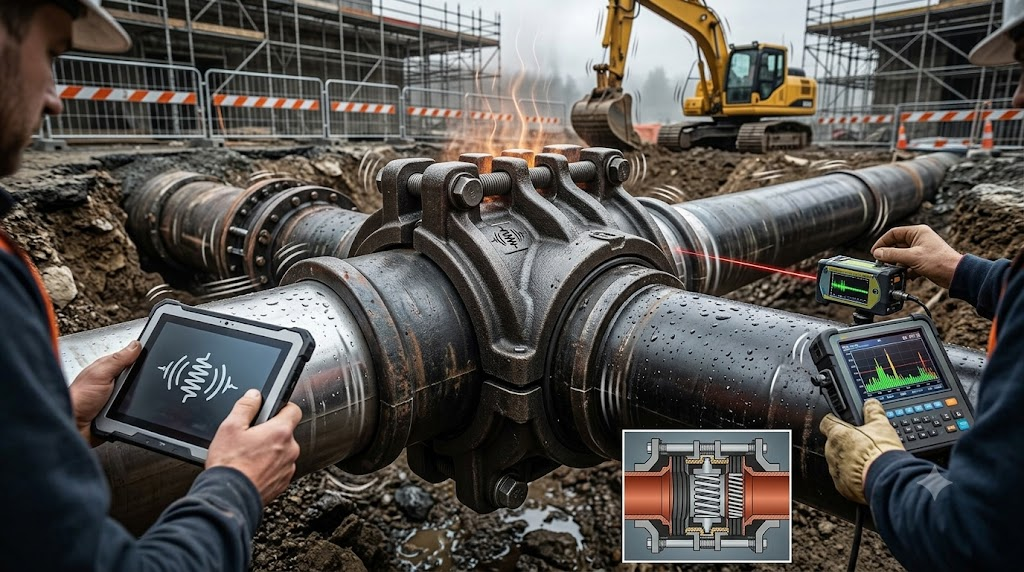
The reducer repair clamp—typically specified as a repair fitting for leaking or damaged pipe transitions—has evolved into a dual-function component. Beyond sealing leaks, properly designed repair clamps serve as anti-vibration expansion joints, absorbing seismic movement, dampening vibration, and accommodating differential settlement without requiring the installation of separate expansion bellows or flexible couplings.
The Seismic Threat to Piping Systems
Earthquake-induced damage to pipelines follows predictable patterns. The most vulnerable points are:
Flanged connections. Rigid flange joints cannot absorb differential movement. When ground subsidence or seismic shaking places stress on flanges, they crack or leak. In one documented case at a nuclear reprocessing facility, underground pipe flanges failed because the pipes sank with the ground following the 2011 Tohoku earthquake. The stress generated by ground subsidence continuously loaded the flange beyond its tensile capacity.
Pipe-to-equipment connections. Fixed equipment and piping move differently during seismic events. Without flexible connections, the rigid attachment points become failure zones.
Transition points and reducers. Where pipe diameters change, stress concentrations are higher. The geometry of reducers makes them particularly susceptible to seismic damage.
Building interfaces. Pipes crossing between buildings or between floors experience differential movement. Flexible connections are required at seismic separations to accommodate these displacements.
The traditional solution to these vulnerabilities has been the installation of dedicated expansion joints—bellows, slip-type joints, or flexible couplings—at strategic points in the piping system. However, these components add cost, require additional space, and introduce new potential leak points.
The Dual-Function Design of Reducer Repair Clamps
The reducer repair clamp addresses seismic protection through a combination of design features that enable it to function simultaneously as a leak repair fitting and an expansion joint.
1. Flexible Clamp Body Construction
Reducer repair clamps are typically constructed from stainless steel halves that encircle the pipe or reducer, secured by high-strength bolts. Unlike rigid welded repairs, the clamp body allows for controlled movement at the joint. The clamp acts as a flexible compensator, absorbing shake and damping vibration.
Some designs incorporate corrugated or bellows-like sections within the clamp structure, providing axial and angular flexibility. The double-flange stainless steel corrugated compensator—a variant of the clamp design—offers excellent flexibility while maintaining corrosion resistance, high-temperature resistance, and high-pressure resistance.
2. Elastomeric Sealing Elements
The sealing system of a reducer repair clamp typically uses EPDM or NBR rubber gaskets that provide both a watertight seal and vibration-damping properties. The rubber gasket absorbs mechanical vibration and dampens shock loads, reducing stress transmission through the piping system.
Some designs incorporate a double rubber seal system that maintains sealing integrity even during angular deflection or axial movement. Clamp-type flexible rubber expansion joints can reduce mechanical vibration by more than 70%.
3. Axial and Angular Movement Absorption
A well-designed reducer repair clamp can accommodate axial movement up to 50mm and angular deflection up to 6°. This flexibility allows the clamp to absorb:
Thermal expansion and contraction. Changes in pipe length due to temperature fluctuations.
Seismic displacement. Ground motion and differential building movement.
Ground subsidence. Settlement that causes pipe misalignment.
Vibration. Mechanical vibration from pumps, compressors, or flow turbulence.
The clamp's flexible design compensates for these movements while maintaining pressure integrity, reducing stress on pipelines and preventing cracks or failures.
How the Double Function Works in Practice
The reducer repair clamp's dual function operates through three interconnected mechanisms:
Mechanism 1: Movement Accommodation
When seismic forces act on a pipeline, the rigid sections of pipe attempt to move in different directions. The reducer repair clamp, installed at critical points such as reducer transitions or flange connections, provides the flexibility needed to accommodate this movement without transferring damaging stress to the pipe wall or joints.
The clamp's bolted design allows for quick installation without welding, enabling retrofit of seismic protection onto existing pipelines. This is particularly valuable for upgrading aging infrastructure in seismic zones where welded modifications would require system shutdown and hot work permits.
Mechanism 2: Vibration Damping
The elastomeric sealing elements within the clamp absorb vibration energy, preventing it from propagating through the piping system. This vibration damping protects:
Flanged connections. Reducing the cyclic stress that leads to flange gasket failure.
Threaded joints. Preventing loosening caused by vibration.
Equipment connections. Protecting pumps, compressors, and valves from vibration-induced damage.
Some clamp designs incorporate dedicated vibration-damping structures with rubber gaskets that are stable, reliable, and capable of reducing vibration transmission.
Mechanism 3: Leak Prevention Under Movement
Traditional rigid repairs or standard couplings cannot maintain a seal when pipes move. Reducer repair clamps maintain sealing integrity even during angular deflection or axial movement because the elastomeric gasket compresses uniformly around the pipe circumference, adapting to changes in pipe position.
A Documented Case Study: The Tokai Reprocessing Plant
The dual-function capability of repair clamps as seismic protection devices is not theoretical—it has been proven in practice.
Following the 2011 Tohoku earthquake, the Tokai Reprocessing Plant in Japan experienced ground subsidence that damaged underground cooling water and fire-fighting water supply pipes. The subsidence caused continuous stress on flanged pipe joints, leading to leakage.
The repair solution was to use a flexible clamp (N-1型クランプ) for pipe connection as a countermeasure for earthquake tremble. The clamp was selected because it could:
Seal the leaking flange without requiring pipe replacement
Follow and absorb ground displacement at the building boundary
Accommodate future seismic movement to prevent recurrence
The technical evaluation confirmed the clamp's performance for practical use. This case demonstrates that repair clamps can serve as both immediate leak repair solutions and long-term seismic protection devices.
Comparison with Dedicated Expansion Joints
Feature | Reducer Repair Clamp | Dedicated Expansion Joint |
Installation | No welding; can be installed on live lines | Often requires welding or flanged connections |
Space requirements | Minimal—fits within pipe envelope | Requires additional clearance for bellows movement |
Cost | Lower—single component, no separate anchors | Higher—requires anchors, guides, and supports |
Seismic movement capacity | Axial up to 50mm, angular up to 6° | Varies by design (often greater range) |
Vibration damping | Integrated elastomeric sealing | Depends on design type |
Leak repair | Yes—primary function | No—installation only |
Retrofit capability | Excellent—can be added to existing pipes | Often requires system redesign |
Selection Criteria for Seismic Applications
When specifying reducer repair clamps for seismic protection, consider the following:
1. Movement Capacity
Verify the clamp's axial, lateral, and angular movement ratings. For seismic zones, choose clamps with proven performance under dynamic loading. Some clamp designs accommodate up to 50mm axial movement and 6° angular deflection.
2. Pressure and Temperature Rating
Seismic clamps must maintain sealing integrity under the system's operating pressure and temperature. Ensure the clamp's rating matches or exceeds the pipeline's design conditions.
3. Material Compatibility
For corrosive environments, specify stainless steel clamp bodies with appropriate elastomer seals (EPDM for general service, NBR for oil resistance, FKM for high-temperature service).
4. Certification and Standards
Look for clamps that meet recognized standards, including ASTM A240 for stainless steel materials and API 5L for piping compatibility. Some applications may require certification by institutions such as DVGW or Lloyd's Register.
5. Installation Accessibility
One of the clamp's key advantages is its ability to be installed without welding, making it suitable for live-line repairs and retrofits. Consider the accessibility of the installation location when selecting clamp designs.
FAQ
Q: Can a reducer repair clamp really replace a dedicated expansion joint?
A: In many seismic applications, yes—for the specific function of absorbing seismic movement and vibration. However, for applications requiring large axial movements (typically >50mm) or high-cycle thermal expansion, a dedicated expansion joint may still be necessary.
Q: How does the clamp absorb seismic movement without leaking?
A: The elastomeric sealing gasket maintains uniform compression around the pipe circumference. As the pipe moves, the gasket adapts to the new position while maintaining the seal.
Q: Is the clamp suitable for high-pressure pipelines?
A: Yes. Reducer repair clamps are available for a wide range of pressures, with some designs rated for pressures up to 300 PSI and above.
Q: Can the clamp be installed on a live pipeline?
A: Yes. One of the primary advantages of repair clamps is the ability to install them without system shutdown, making them suitable for emergency repairs and seismic retrofits.
Q: What is the typical service life of a reducer repair clamp in seismic service?
A: With proper material selection (stainless steel + appropriate elastomer), clamps can provide long-term service comparable to the pipeline itself. The Tokai facility's use of clamps as a permanent seismic countermeasure demonstrates their durability.
Q: How does the clamp compare to welded repairs for seismic zones?
A: Welded repairs are rigid and cannot accommodate movement. The clamp's flexibility makes it superior for seismic applications, as it absorbs rather than resists movement.
Final Thoughts
The reducer repair clamp has evolved from a simple leak repair device into a sophisticated dual-function component that addresses two critical pipeline challenges simultaneously: sealing leaks and providing seismic protection. By accommodating axial movement, angular deflection, and vibration while maintaining a leak-tight seal, these clamps offer a cost-effective alternative to dedicated expansion joints in many seismic applications.
The documented success at the Tokai Reprocessing Plant demonstrates that repair clamps can serve as effective countermeasures for earthquake tremble. Their ability to be installed without welding, on live lines, and in confined spaces makes them particularly valuable for seismic retrofits of existing pipelines.
For engineers and facility managers in seismic zones, the reducer repair clamp represents a practical, proven solution—one component that does the work of two, reducing cost, space requirements, and potential failure points while increasing pipeline resilience.