
June 27, 2026
Sleeve Repair Clamp vs. Standard Couplings: Choosing the Right Fitting for Flange Obstructions
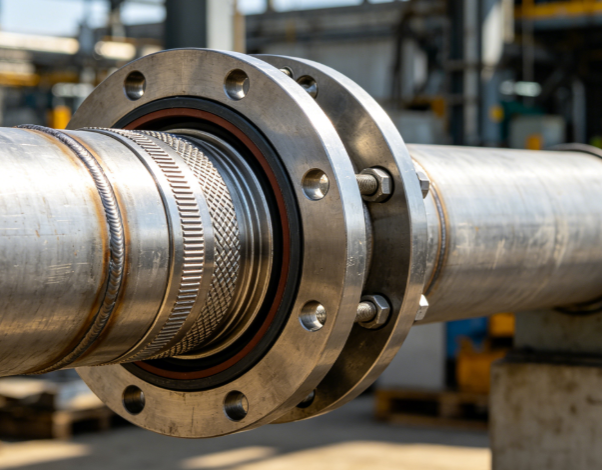
Introduction
Anyone who's spent time in the field knows the frustration. You're on-site, ready to make a repair or connection, and there it is—a flange, a valve, or some other fitting sitting right where you need to work. Standard couplings won't fit. You can't slide them over the pipe because the flange is in the way. And cutting out the flange? That means shutting down the line, draining the system, and adding hours—sometimes days—to the job.
This is where the sleeve repair clamp enters the conversation. But before we get into that, let's be clear about something: a repair clamp and a coupling are not the same thing, and using one in place of the other is one of the most common—and costly—mistakes made in pipeline maintenance.
Let's break down what each fitting does, when you should use one over the other, and how to navigate the specific challenge of working around flange obstructions.
What Is a Standard Coupling?
A standard coupling is designed to connect two pipe ends together permanently. It's a joining device, plain and simple. You slide it over the ends of two pipes, tighten it down, and it creates a sealed, structural connection between them.
Couplings come in many varieties—mechanical couplings, split-sleeve couplings, transition couplings—but they all serve the same fundamental purpose: joining pipe to pipe.
Here's what makes a coupling different from a repair clamp:
They provide structural integrity. A coupling isn't just sealing a leak—it's bearing load and connecting two sections of pipe as if they were one continuous piece.
They accommodate movement. Quality couplings offer dynamic deflection—typically up to 3 to 4 degrees on each side—which allows the joint to flex with ground movement, thermal expansion, and other forces.
They're designed for long-term service. A properly installed coupling is a permanent solution, not a temporary patch.
The catch? Standard couplings require access to the pipe ends. You need to be able to slide the coupling over the pipe. If there's a flange, a bell, or any other obstruction in the way, you can't get the coupling into position without cutting or removing that obstruction.
What Is a Sleeve Repair Clamp?
A sleeve repair clamp—also called a repair clamp, band clamp, or split-sleeve repair clamp—is designed to repair damage to an existing pipe without cutting out the damaged section.
These are the fittings you reach for when you've got a hole, a crack, a pinhole leak, or localized corrosion on a pipe that's otherwise sound. You wrap the clamp around the damaged area, tighten the bolts, and the gasket seals against the pipe surface to stop the leak.
Key characteristics of sleeve repair clamps:
They wrap around the pipe. Unlike couplings, repair clamps don't need to be slid over the end of the pipe. They open up, go around the pipe, and close back down.
They seal, but they don't structurally connect. A repair clamp is a patch. It seals a leak, but it doesn't bear load or connect two pipe sections together.
They're a temporary or semi-permanent solution. In many cases, repair clamps are considered a stopgap—a way to get the system back online while planning a permanent repair.
Here's the important part: a repair clamp is not a coupling. It's not designed to join two pipe ends. It's designed to seal a hole. Using a clamp where a coupling is needed is a shortcut that almost always leads to failure.
The Flange Obstruction Problem
Now let's get to the specific scenario that brings these two fittings into conflict.
You've got two pipe ends that need to be connected. Maybe you're replacing a damaged section. Maybe you're installing a new valve or fitting. But there's a flange—or a bell, or some other oversized component—on one or both of the pipes.
A standard coupling won't work because you can't slide it over the flange. The flange is wider than the pipe body, and the coupling won't pass over it.
So what are your options?
Option 1: Cut out the flange. This means shutting down the line, draining it, cutting the flange out, and then using standard couplings to connect the remaining pipe ends. It's a permanent solution, but it's expensive, time-consuming, and disruptive.
Option 2: Use a sleeve repair clamp as a coupling. This is the shortcut. You wrap a repair clamp around the two pipe ends and call it a day. It's fast, it's cheap, and it works—for a while.
Option 3: Use an openable or wraparound coupling. This is the correct solution. These are couplings designed specifically for situations where you can't slide a standard coupling over the pipe. They open up, wrap around the pipe ends, and close down—just like a repair clamp—but they provide the structural integrity and deflection capacity of a proper coupling.
Why You Shouldn't Use a Repair Clamp as a Coupling
I've seen this mistake more times than I can count. A crew uses a repair clamp to join two pipes because it's faster and easier than doing it right. Here's why that's a bad idea:
Repair clamps offer no deflection capacity. Standard repair clamps don't accommodate ground movement, thermal expansion, or any other forces that act on the pipe. When the ground shifts—and it will—the clamp doesn't flex. The pipe breaks somewhere else.
They don't provide structural continuity. A coupling connects two pipe ends as if they're one piece. A repair clamp just wraps around them. It doesn't transfer load across the joint.
They fail under pressure. As pipe diameter increases, the pressure-holding capability of a clamp decreases. A clamp that works fine on a 4-inch line may not hold on a 24-inch line, especially under high pressure.
They lead to recurring failures. External forces continue to act on the pipe after the clamp is installed. Without deflection capacity, the pipe will break again—often right next to the clamp.
They waste time and money. The "quick fix" almost always ends up costing more in the long run—more repairs, more downtime, more water loss.
The Right Solution: Openable or Wraparound Couplings
When you're faced with a flange obstruction, the correct solution is an openable or wraparound coupling.
These are couplings that can be opened up and wrapped around the pipe—just like a repair clamp—but they provide the performance of a proper coupling:
They provide structural integrity. They connect the two pipe ends properly, bearing load and maintaining the pipeline's structural continuity.
They offer dynamic deflection. Quality openable couplings provide up to 3 degrees of deflection on each side, accommodating ground movement and preventing future breaks.
They're a permanent solution. These aren't temporary patches. They're designed for long-term service.
They install without cutting out the flange. You don't need to remove the obstruction. You just open the coupling, wrap it around the pipe ends, and close it.
The openable split-sleeve coupling is gaining traction in the U.S. water industry and has already gained wide acceptance in many parts of Europe. For bell or sleeve joint repairs, the damaged section is cut out, and the openable coupling is used to complete the repair.
Side-by-Side Comparison
Factor | Standard Coupling | Sleeve Repair Clamp | Openable/Wraparound Coupling |
Primary Purpose | Join two pipe ends | Seal a leak/hole | Join two pipe ends in obstructed spaces |
Installation | Slide over pipe end | Wrap around pipe | Wrap around pipe |
Flange Obstruction | Cannot pass over flanges | Can bypass flanges | Can bypass flanges |
Deflection Capacity | Yes (3-4 degrees) | None | Yes (up to 3 degrees) |
Structural Integrity | Full | None | Full |
Permanence | Permanent | Temporary/Semi-permanent | Permanent |
Best Use Case | New installations, open access | Holes, cracks, pitting | Repairs near flanges, bells, valves |
A Quick Word on Flange-Specific Repair Clamps
It's worth noting that there are also flange repair clamps designed specifically to seal leaks at flange joints. These are different from both standard couplings and sleeve repair clamps.
A flange repair clamp wraps around the flange itself—not the pipe body—and seals leaking flange gaskets. These are useful when the leak is at the flange joint, not on the pipe. They're a specialized tool for a specific problem, and they're not designed for joining pipe ends.
FAQ
Q: Can I use a repair clamp to connect two pipes if there's a flange in the way?
A: Technically, yes—you can physically wrap a repair clamp around two pipe ends. But you shouldn't. Repair clamps are not designed to couple pipe. They offer no deflection capacity and will fail over time due to ground movement and other forces. Use an openable coupling instead.
Q: What's the difference between a repair clamp and an openable coupling?
A: A repair clamp is a patch—it seals leaks but doesn't provide structural connection or deflection capacity. An openable coupling provides full structural integrity and dynamic deflection, just like a standard coupling, but can be wrapped around the pipe instead of slid over the end.
Q: What is "dynamic deflection" and why does it matter?
A: Dynamic deflection is the ability of a coupling to flex and accommodate movement—ground settlement, thermal expansion, seismic activity—without breaking. Pipes move. If your connection can't move with them, something will break. Repair clamps offer no deflection, which is why they fail when used as couplings.
Q: When should I use a standard coupling instead of an openable coupling?
A: When you have open access to the pipe ends and no obstructions in the way. Standard couplings are simpler, less expensive, and widely available. But if there's a flange, bell, valve, or any other obstruction that prevents sliding the coupling over the pipe, you need an openable coupling.
Q: Are openable couplings as strong as standard couplings?
A: Yes. Quality openable couplings provide the same structural integrity, pressure rating, and deflection capacity as standard couplings. They're not a compromise—they're the right tool for a specific situation.
Final Thoughts
Here's the bottom line.
If you're connecting two pipes and there's no obstruction in the way, use a standard coupling. It's the right tool for the job.
If you're repairing a hole, crack, or pinhole leak, use a sleeve repair clamp. That's what it's designed for.
But if you're connecting two pipes and there's a flange—or a bell, a valve, or any other obstruction—blocking the path of a standard coupling, do not use a repair clamp as a shortcut. That's not a repair. It's a future failure waiting to happen.
Use an openable or wraparound coupling instead. It installs around the obstruction, provides full structural integrity, accommodates movement, and delivers a permanent solution. The upfront cost is marginally higher, but the long-term savings in avoided failures, reduced downtime, and lower maintenance make it the smarter choice every time.
Choose wisely.