
June 27, 2026
How a Gearbox Repair Fixture Improves Maintenance Efficiency
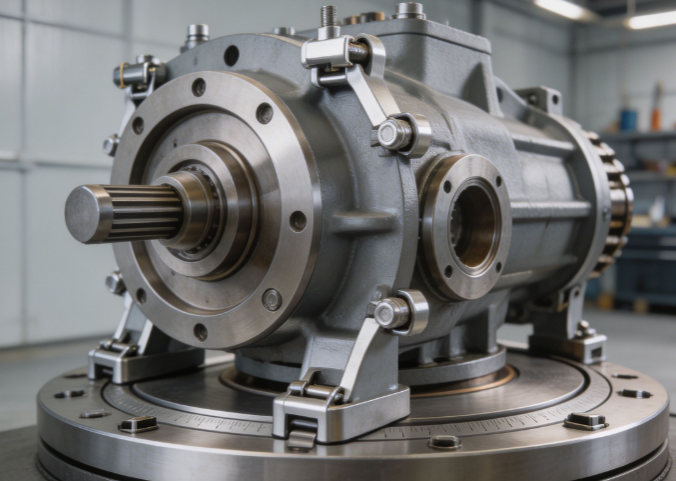
Walking through a heavy equipment maintenance shop, you will see gearboxes in various states of disassembly. Some are laid out on wooden blocks. Some are chained to overhead cranes. A few are mounted on improvised stands that were never designed to hold them. The mechanic working on the best-organized job is not the one with the most experience or the best tools. It is the one whose gearbox is secured in a purpose-built repair fixture. That mechanic is working faster, safer, and with both hands free. The difference is not skill. It is workholding.
Gearbox repair fixtures do not turn wrenches. They do not diagnose faults or measure clearances. What they do is eliminate the single largest non-value-added activity in gearbox maintenance: the constant repositioning, re-rigging, and improvisation that consumes hours of a mechanic's day when the gearbox is not properly held. A fixture transforms gearbox repair from an exercise in creative problem-solving into a repeatable, controlled process. The efficiency gains are not marginal. They are structural.
The Problem Fixtures Solve
A gearbox on a repair stand that was not designed for it is never in the right position. The mechanic needs to access the input shaft, so the gearbox is rotated. Now the drain plug is on the bottom and the fill port is blocked. The gearbox is rotated again. The overhead crane is tied up for each repositioning. A second mechanic is pulled off another job to help guide the load. A two-minute access task has consumed fifteen minutes of labor and a crane cycle.
The same scenario plays out hundreds of times across a gearbox overhaul. A study of manual work in assembly and maintenance identifies searching, reaching, and repositioning as the three largest sources of wasted motion. A repair fixture eliminates all three for the specific gearbox it is designed to hold. The mechanic reaches for the right tool, in the right position, without moving the gearbox. The work flows around the gearbox, not the other way around.
Beyond time, there is the problem of safety. A gearbox weighing several hundred kilograms, suspended from a crane or balanced on blocks, is a hazard. A purpose-built fixture captures the gearbox at its designed lifting and mounting points. The load is stable. The mechanic is not working under a suspended load. The safety improvement alone often justifies the fixture investment in operations where a recordable injury carries costs that dwarf any tooling budget.
How Fixtures Unlock Efficiency
The primary mechanism is ergonomic positioning. A well-designed fixture holds the gearbox at the correct working height with full 360-degree rotation, allowing the mechanic to bring the work to themselves rather than contorting their body to reach it. The same overhaul that takes three shifts on a fixed stand can be completed in two when the gearbox can be rotated to present each face at the optimal angle.
The secondary mechanism is tool and parts organization. Fixtures designed with integrated tool trays, parts bins, and disassembly sequencing guides keep components organized as they are removed. A gearbox that is disassembled on a fixture with sequenced parts storage goes back together faster and with fewer assembly errors than one where parts are laid out on a bench in the order they were removed. Missing a shim or reinstalling a bearing in the wrong orientation are errors that a well-organized fixture makes visible before the gearbox is closed.
The tertiary mechanism is process standardization. When every mechanic uses the same fixture for the same gearbox model, the disassembly and reassembly sequence becomes standardized. The fixture itself becomes a training aid. A new mechanic learns the correct sequence by following the fixture's layout. The variability between mechanics—a major source of quality problems in gearbox overhaul—is reduced. The gearbox that comes off the fixture at the end of the shift has been rebuilt the same way, regardless of who turned the wrenches.
What a Good Fixture Looks Like in Practice
A properly designed gearbox repair fixture addresses the entire maintenance workflow, not just the holding function. The mounting interface uses the gearbox's own bolt pattern rather than clamping on machined surfaces. A fixture that clamps the gearbox housing can distort it. A fixture that bolts to the housing using the same fasteners and torque sequence as the machine installation replicates the in-service mounting condition, which is the correct condition for measuring bearing preload and gear mesh.
Rotation capability with locking at discrete positions—typically every 30 or 45 degrees—allows the mechanic to access every face without fighting gravity. The locking mechanism must be positive, not friction-based. A gearbox that slips during a bearing pull is a near-miss waiting to become an injury.
Integrated lifting points allow the entire fixture-gearbox assembly to be moved as a unit. This eliminates the separate rigging and de-rigging steps that consume crane time. A fixture that arrives at the work area with the gearbox already mounted and rotates into position without additional crane support keeps the crane available for other jobs.
Drainage and fluid containment prevent oil from pooling on the floor around the work area. A fixture with a built-in drain pan and a collection port for waste oil keeps the work area clean and reduces slip hazards.
Material selection for the fixture structure is a balance of rigidity and weight. The fixture must be stiff enough to hold alignment during bearing pressing operations—forces that can exceed several tons—yet light enough to be moved by a single mechanic or a small forklift. Welded steel construction with stress-relieved joints is the standard for durability. Cast iron is used where vibration damping is required, though it adds weight.
Quantifying the Impact
The table below compares key maintenance metrics for a mid-sized industrial gearbox overhaul with and without a purpose-built repair fixture.
Metric | Without Fixture | With Fixture | Improvement |
Total overhaul time | 24–32 hours | 16–20 hours | 30–40% reduction |
Crane utilization | 8–12 lifts per overhaul | 2–3 lifts per overhaul | 70–80% fewer crane cycles |
Mechanics required | 2 (one for crane, one for work) | 1 (both hands free) | 50% labor reduction |
Assembly errors (rework rate) | 5–10% of overhauls | <2% of overhauls | 60–80% fewer errors |
Safety incidents (near-miss or injury) | Elevated risk from suspended loads | Significantly reduced | Risk nearly eliminated |
Training time for new mechanic | 3–5 supervised overhauls | 1–2 supervised overhauls | 50–60% faster proficiency |
These figures are based on field observations across multiple heavy equipment maintenance facilities. Actual results vary with gearbox size, complexity, and the existing state of shop tooling.
ROI: The Numbers That Matter
A gearbox repair fixture for a common industrial gearbox model typically costs $3,000 to $12,000, depending on size, complexity, and the degree of customization. The payback calculation is straightforward.
A shop that overhauls 20 gearboxes per year, saving 8 hours of labor per overhaul at a loaded labor rate of $75 per hour, saves $12,000 per year in direct labor. Add the avoided cost of one assembly error per year—a gearbox returned from the field after a premature bearing failure, costing $5,000 in parts, freight, and repair labor—and the total annual savings exceed $15,000. The fixture pays for itself within the first year of operation.
The labor savings alone typically justify the fixture. The safety improvement, the quality improvement, and the crane availability improvement are additional returns that do not appear in the direct payback calculation but are visible in the shop's overall performance metrics. A shop that reduces its average gearbox overhaul time from 28 hours to 18 hours does not just save 10 hours of labor. It increases its throughput capacity by over 50% for the same floor space and the same number of mechanics.
FAQ
Q: Is a custom fixture worth the investment for a shop that overhauls only a few gearboxes per year?
A: It depends on the gearbox size and the cost of downtime. For a gearbox that takes two mechanics three shifts to overhaul without a fixture, the labor savings on even three overhauls per year can justify a simple fixture. For a small, bench-top gearbox that one mechanic can handle, a universal bench vise with soft jaws may be adequate.
Q: Can one fixture be used for multiple gearbox models?
A: Yes, if the mounting interface is designed with interchangeable adapter plates. The base fixture—rotation mechanism, locking system, drain pan—is common. Adapter plates specific to each gearbox model bolt to the base. This approach reduces the per-model fixture cost while retaining most of the efficiency benefits.
Q: What is the most important design feature of a gearbox repair fixture?
A: The mounting interface. A fixture that does not hold the gearbox securely at its correct mounting points is not a repair fixture. It is a stand. The mounting must replicate the in-service bolt pattern and torque, and the fixture must be rigid enough to resist the forces of bearing pressing and gear pulling without deflection.
Summary
A gearbox repair fixture improves maintenance efficiency by eliminating the wasted motion of repositioning, re-rigging, and improvising. It holds the gearbox securely at the correct working height with controlled rotation, allowing a single mechanic to work with both hands free and without crane support for every access change. The result is a 30–40% reduction in overhaul time, a 50% reduction in labor requirements, and a measurable drop in assembly errors.
The fixture pays for itself in direct labor savings, usually within the first year. But its real value is in transforming gearbox overhaul from a variable, crane-dependent, two-person operation into a standardized, single-person process. A shop that equips its workstations with the right fixtures does not just repair gearboxes faster. It repairs them better, with fewer mistakes, and with mechanics who go home at the end of the shift without the fatigue that comes from fighting a gearbox that was never in the right position.