
October 15, 2026
NPT, BSP, and Compression Threads: Understanding Fitting Connection Standards Globally
1. Introduction
I've been specifying piping components for international industrial projects for close to a decade. Started on the maintenance side in the U.S., moved into project engineering, and for the last several years I've been helping procurement teams navigate the thread standard maze that causes more installation failures than any other single factor in global piping projects.
And I can tell you this: the most expensive thread mistake I've seen didn't happen in the field. It happened in the procurement office. A project manager in Houston ordered NPT-threaded valves for a plant being built in Malaysia. The local piping contractor, working to British-derived standards, had already installed BSPT-threaded pipe nipples. The two thread systems share the same 1:16 taper rate, which means they start to thread together. They just don't seal.
The plant spent three days chasing leaks, replaced the sealant twice, and ultimately cut out and re-threaded six feet of stainless steel pipe. The total cost was $200,000 in lost production and emergency labor — all because someone assumed “tapered pipe thread” meant the same thing everywhere.
This isn't an isolated incident. It's a systemic problem in global piping procurement. The global pipe fittings market was valued at approximately USD 93.65 billion in 2026 and is projected to reach USD 143.63 billion by 2033, growing at a CAGR of 6.3%. As supply chains become more international, the probability of thread standard mismatches increases proportionally.
Here's the core problem. The difference between NPT and BSP threads is a 5-degree thread angle (60° vs 55°). That 5 degrees is invisible to the naked eye. It's nearly impossible to detect without a thread gauge. And it's enough to turn a $5 fitting into a $200,000 field failure.
This guide breaks down the thread standards that govern global piping connections — NPT, BSP, and compression — the sealing mechanisms, the compatibility rules, and the field identification methods that prevent the mistakes I've seen repeat across too many projects.
2. Why Thread Standards Are a Global Procurement Problem
Before diving into the thread geometry, let's establish why this matters more now than it did a decade ago.
Supply chains have globalized faster than standards have harmonized. A plant in Southeast Asia may use BSP threads for the main process piping, NPT threads for imported American instrumentation, and metric threads for European pump connections. Each system has its own sealing mechanism, and none of them are interchangeable.
The visual similarity creates false confidence. NPT and BSPT threads share the same taper rate (1:16) and similar nominal sizes. A 1/2-inch NPT fitting and a 1/2-inch BSPT fitting will thread together several turns by hand. This “it started by hand” moment is the most dangerous point in the installation — because it convinces the installer that the threads match when they don't.
The failure is delayed. A mismatched thread joint may hold pressure during the initial test. The leak path created by the 5-degree flank angle mismatch is a spiral channel that sealant can temporarily block. The joint passes the hydrostatic test. Then, weeks or months later, thermal cycling, vibration, or pressure fluctuations open the leak path.
The cost of correction is asymmetric. Preventing the mistake costs a thread gauge and five minutes of verification. Correcting it costs pipe replacement, re-threading, production downtime, and in some cases, structural repairs to equipment that was damaged during the attempted installation.
3. The Three Thread Families Explained
Global piping connections are governed by three distinct standards families. Understanding the difference between these families is the foundation of correct selection.
ASME B1.20.1 covers five general-purpose inch pipe-thread forms, including NPT (National Pipe Taper). This is the North American standard, used primarily in the United States and Canada.
ISO 7-1 (formerly BS 21) covers the British-derived tapered pipe thread system, commonly called BSPT (British Standard Pipe Taper) or R/Rc/Rp threads. This is the dominant system in Europe, Asia, Australia, and most Commonwealth countries.
ISO 228-1 covers parallel pipe threads designated as G (BSPP — British Standard Pipe Parallel). These threads do not seal on the thread itself; they seal on an external surface such as a gasket, O-ring, or bonded washer.
Metric threads (ISO 261) are a separate family used primarily in hydraulic systems and precision machinery. They are typically parallel and seal through a combination of thread engagement and a sealing element such as an O-ring or metal washer.
Here's the critical distinction that catches most engineers off guard: “BSP” is a commercial label, not an engineering specification. BSPP often means an ISO 228 G thread. BSPT often means an ISO 7 R-family thread. These are two entirely different sealing systems that happen to share the “BSP” abbreviation.
A correct specification must include the exact standard designation — not just “BSP.” When a drawing says “1/2 BSP,” it's ambiguous. When it says “R 1/2 ISO 7-1,” it's precise.
4. NPT: The North American Standard
NPT (National Pipe Taper) is the general-purpose tapered pipe thread standard for North America, governed by ASME B1.20.1.
Geometry and Sealing
NPT threads use a 60-degree thread angle with a 1:16 taper (3/4 inch per foot). The thread form is a sharp “V” with truncated crests and roots. Sealing is achieved through thread deformation — as the tapered male thread wedges into the tapered female thread, the flanks deform slightly, creating a metal-to-metal seal. Thread sealant (PTFE tape or pipe dope) fills the remaining spiral leak path.
Thread Pitch by Size
Nominal Size | NPT TPI | BSPT TPI |
1/8" | 27 | 28 |
1/4" | 18 | 19 |
3/8" | 18 | 19 |
1/2" | 14 | 14 |
3/4" | 14 | 14 |
1" | 11.5 | 11 |
1-1/4" | 11.5 | 11 |
1-1/2" | 11.5 | 11 |
2" | 11.5 | 11 |
Sources: Projectmaterials NPT vs BSPT comparison table
The TPI values differ at most sizes — and even where they match (1/2" and 3/4"), the thread angle difference (60° vs 55°) means the threads cannot properly seat against each other.
Where NPT Is Used
NPT is the standard for North American piping systems. It's specified in ASME B31.3 for process piping, ASME B16.5 for threaded flanges, and is the dominant thread system for oil and gas, heavy industrial, and instrumentation connections in the Americas.
5. BSP: The British and International Standard
“BSP” encompasses two distinct thread systems that share a 55-degree Whitworth thread form but differ fundamentally in how they seal.
BSPT (Tapered) — ISO 7-1 R/Rc/Rp
BSPT threads use the Whitworth thread form with a 55-degree thread angle and rounded crests and roots. The taper rate is 1:16, identical to NPT. Sealing is achieved through thread interference, similar to NPT but with the 55-degree flank angle.
The ISO 7-1 designation system uses:
R — external taper thread
Rc — internal taper thread (mates with R)
Rp — internal parallel thread (mates with R)
A joint specified as “R 1/2” is an external taper thread that will mate with an Rc or Rp internal thread. This precision matters — a drawing that says “BSPT 1/2” is less precise than one that says “R 1/2 ISO 7-1.”
BSPP (Parallel) — ISO 228-1 G Thread
BSPP threads are parallel (no taper). The thread form is 55-degree Whitworth, but the sealing mechanism is completely different. BSPP threads do not seal on the thread. ISO 228-1 explicitly states that G threads from 1/16 through 6 are not suitable where the pressure-tight joint is made on the thread.
Sealing is achieved through a separate sealing surface — a bonded washer, copper gasket, or O-ring compressed against a machined face. No thread sealant is needed because the threads aren't doing the sealing.
Where BSP Is Used
BSP threads are the standard in Europe, the Middle East, Africa, and Asia (except Japan and Korea, which use their own standards). They're specified in EN 10226-1 for European piping and are the dominant system for water treatment, commercial construction, and general fluid systems globally.
6. Compression Fittings: A Different Sealing Philosophy
Compression fittings don't rely on thread sealing at all. They use a mechanical compression principle that's fundamentally different from both NPT and BSP tapered threads.
How They Work
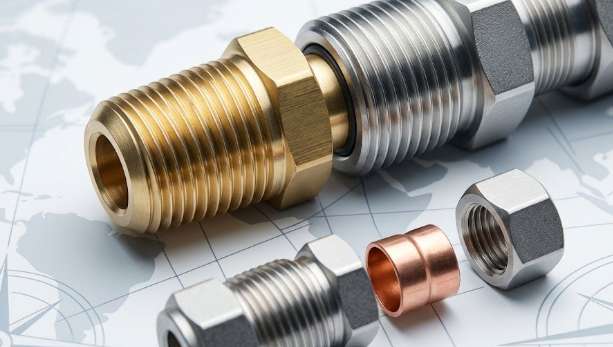
A compression fitting consists of three components: a fitting body, a compression ring (ferrule), and a compression nut. When the nut is tightened, it compresses the ferrule against the pipe surface and the fitting body, forming a watertight seal without any thread engagement on the pipe itself.
The seal is created by the ferrule biting into the pipe surface, not by the threads. This means the threads on a compression fitting are purely mechanical — they hold the nut in place, but they don't contribute to the seal.
Advantages and Limitations
Installation is faster and simpler. No threading, soldering, or special equipment is needed. The pipe is cut squarely, deburred, inserted into the fitting body, the ferrule is placed, and the nut is tightened. Most compression joints can be completed in under 3 minutes.
The seal is reliable when properly installed. Because the ferrule creates a mechanical bite into the pipe, the connection is less dependent on thread quality than NPT or BSPT joints. Compression fittings can be used in high-pressure applications and may become more reliable as pressure increases, as the pressure tends to expand the tube against the ferrule.
But compression fittings have their own failure modes. The ferrule can back off under sustained vibration. The connection is not easily reusable — once the ferrule has been compressed, removing and reinstalling the fitting requires a new ferrule. And the installation requires precise pipe preparation — a square cut and proper deburring are essential for a good seal.
When to Choose Compression Over Threaded
Compression fittings are the practical choice for:
Instrumentation and control systems where precise, leak-free connections are required
Copper and plastic tubing where threading isn't practical
Field repairs where threading equipment isn't available
Areas where open flame (soldering) is prohibited
Threaded fittings remain the standard for:
High-pressure steel pipe systems (NPT rated up to 6,000+ PSI)
Large-diameter piping where compression fittings aren't available
Applications requiring reassembly (threaded joints can be disassembled and re-sealed)
7. Side-by-Side Comparison: The Data That Drives Selection
Here's the comparison table I use when evaluating fitting connection standards for a global project.
Parameter | NPT | BSPT (R/Rc) | BSPP (G) | Compression |
Standard | ASME B1.20.1 | ISO 7-1 / EN 10226-1 | ISO 228-1 | Various (per manufacturer) |
Thread angle | 60° | 55° | 55° | N/A (mechanical) |
Taper | 1:16 | 1:16 | None (parallel) | N/A |
Sealing method | Thread deformation + sealant | Thread interference + sealant | Gasket/O-ring on seat | Ferrule compression |
Sealant required? | Yes (PTFE tape or dope) | Yes (PTFE tape or dope) | No | No |
Primary regions | North America | Europe, Asia, Australia | Europe, Asia | Global (instrumentation) |
Max pressure | 6,000+ PSI (steel) | 6,000+ PSI (steel) | Varies by seal | 300–1,200 PSI |
Reusable? | Yes (with fresh sealant) | Yes (with fresh sealant) | Yes (with new gasket) | Limited (ferrule replacement) |
Vibration resistance | Moderate | Moderate | Moderate | Low (ferrule can back off) |
Thread identification | Flattened crests | Rounded crests | Rounded crests | N/A |
Sources: Projectmaterials NPT vs BSPT comparison; Rodless Pneumatic thread type guide; Plastic Pipe Valve fitting comparison; Titan Fluid thread guide
8. Why NPT and BSP Cannot Be Mixed
This section is the most important in this guide, because thread mixing is the leading cause of fitting failures in international projects.
The Three Failure Mechanisms
Thread angle mismatch. NPT has a 60-degree flank angle; BSP has a 55-degree flank angle. When an NPT male is threaded into a BSPT female, the flanks don't make full contact. Only the crests and roots touch, creating a spiral leak path that sealant can't reliably block.
Pitch mismatch. At most sizes, the TPI values differ between NPT and BSPT. A 1/4" NPT has 18 TPI; a 1/4" BSPT has 19 TPI. The threads bind after only a few turns, preventing proper engagement and creating stress concentrations at the contact points.
Galling and port damage. Forcing a mismatched thread creates point contact that can cause galling (cold welding) on stainless steel or cracking the female port on brass or plastic. I've personally cut apart three stainless steel valves that were cross-threaded beyond recovery because an operator forced an NPT nipple into a BSPT port because “it started by hand.”
The Sealing Mechanism Difference
Even when threads physically engage, the sealing mechanisms differ. NPT and BSPT rely on thread flank interference — the threads deform as they tighten, creating a metal-to-metal seal. This requires full flank contact, which the 5-degree angle mismatch prevents.
BSPP doesn't seal on the thread at all. It seals on a gasket or O-ring compressed against a machined face. Threading a BSPP fitting into an NPT port doesn't create the sealing surface the fitting needs.
The Correct Solution
When you encounter a thread mismatch, the solution is never to force the connection or add more sealant. The correct approach is:
Identify the port thread standard using a thread gauge or the visual identification methods described below
Use a thread adapter that has the correct male and female threads for both sides
If no adapter exists, replace the fitting, not the port — because modifying an existing port can compromise the structural integrity of the equipment
The Vega hydraulic cylinder case illustrates this last point precisely. A customer with NPT oil ports wanted to convert to BSP to stop leaks. The technical team determined that modifying the existing NPT port wasn't possible because there wasn't enough material thickness to machine a new BSP thread without risking cylinder body failure. The correct solution was to replace the entire cylinder body with one equipped with standard BSP ports.
9. Real-World Case: The $200,000 Thread Mismatch
The Louisiana chemical plant leak I mentioned earlier is worth examining in detail, because it illustrates how a thread mismatch propagates through a project.
The Situation: A 2-inch stainless steel valve was leaking at the pipe connection. The maintenance team replaced the sealant, re-taped the threads, and even welded a support bracket to reduce vibration. Nothing worked.
The Root Cause: The valve had NPT threads. The pipe nipple was BSPT. The two thread forms share a taper rate of 1:16, which allowed them to thread together several turns by hand. The 5-degree flank angle mismatch (60° vs 55°) created a spiral leak path that no amount of PTFE tape could seal.
The Cost: The plant eventually cut out six feet of pipe and re-threaded everything. Total cost: $200,000 in lost production and emergency labor.
The Broader Lesson: This case wasn't caused by incompetent maintenance. It was caused by a specification that said “tapered pipe thread” without specifying the standard. The procurement team assumed that “tapered” meant the same thing everywhere. It doesn't.
A second case from the oil and gas sector reinforces the point. A Vega hydraulic cylinder with NPT oil ports was experiencing persistent leaks. The customer had tried multiple sealing methods without success. The Vega technical team's conclusion was that NPT and BSP connections should not be considered interchangeable — they are different thread systems with different sealing mechanisms, and the preferred solution was a BSP connection rather than attempting to modify the existing NPT port.
10. Field Identification: How to Tell Them Apart
Here are the field identification methods I use when I need to determine whether a fitting is NPT or BSP without a thread gauge.
Visual Method: Look at the Crests
NPT threads have flattened or truncated crests — they look slightly “flat” on top. BSP threads have rounded crests — more like a smooth arc. This is the most reliable visual indicator, but it requires good lighting and a magnifying glass for smaller sizes.
Thread Pitch Gauge Method
NPT uses threads per inch (TPI) for sizing. A 1/2" NPT has 14 TPI; a 1/4" NPT has 18 TPI. BSP also uses TPI, but the values differ at most sizes. A 1/4" BSPT has 19 TPI, not 18.
Use a thread pitch gauge designed for each standard. The gauge will show whether the thread pitch matches the expected value for the nominal size.
Fit Test Method
If you have a known NPT fitting and a known BSP fitting of the same nominal size, try both. The correct thread will thread on smoothly by hand and seat properly. The incorrect thread will bind after a few turns or will thread on but feel loose or wobbly.
Warning: Never force a thread that binds. The 5-degree mismatch creates point contact that can gall stainless steel or crack brass and plastic ports.
The Tape Test
Wrap the male thread with PTFE tape and thread it into the female port. Tighten to the expected torque. Then remove the fitting and examine the tape. If the tape is cut or distorted in a pattern consistent with full thread engagement, the threads match. If the tape shows only partial contact marks at the crests, the threads are mismatched.
11. A Practical Selection Framework for Global Projects
Here's the framework I use when specifying thread standards for international piping projects.
Step 1: Identify the Project's Governing Standard
Determine which standard governs the project. North American projects (ASME B31.3) use NPT. European projects (EN 13480) use BSPT. Middle Eastern and Asian projects typically follow either European or American standards depending on the engineering contractor.
Step 2: Verify the Equipment Connections
Equipment imported from different regions may have different thread standards. An American pump skid may have NPT ports; a European control valve may have BSP ports. Document every connection point and its thread standard before ordering any fittings.
Step 3: Specify the Exact Standard on Every Drawing
“BSP” is not a complete specification. Write “R 1/2 ISO 7-1” for a tapered BSP external thread. Write “G 1/2 ISO 228-1” for a parallel BSP thread. Write “1/2 NPT ASME B1.20.1” for a North American tapered thread.
Step 4: Stock Adapters, Not Assumptions
Maintain an inventory of thread adapters at the project site. A BSP-to-NPT adapter costs far less than re-threading six feet of pipe. For instrumentation connections, specify adapters in the purchase order rather than assuming the field installation team will have them.
Step 5: Verify at Receipt, Not at Installation
Inspect every fitting against a thread gauge when it arrives at the warehouse. The cost of a thread gauge is trivial compared to the cost of a field failure. A fitting that fails the gauge check should be quarantined before it reaches the installation team.
12. Common Questions About Thread Standards
Q: Can I use an NPT fitting in a BSP port if I use enough PTFE tape?
No. PTFE tape fills gaps between thread surfaces, but it cannot compensate for the fundamental thread form mismatch. The 5-degree flank angle difference creates a spiral leak path that no amount of tape can reliably seal. The joint may pass initial testing but will leak under thermal cycling, vibration, or pressure fluctuation.
Q: What's the difference between BSPP and BSPT?
BSPP (ISO 228 G) is a parallel thread that seals on an external surface — a gasket or O-ring. BSPT (ISO 7 R) is a tapered thread that seals on the thread itself through interference. They share the same 55-degree Whitworth thread form but have completely different sealing mechanisms and are not interchangeable.
Q: How do I know which thread standard is used in my facility?
Check the piping and instrumentation diagrams (P&IDs) or the project's piping specification. If those aren't available, use a thread gauge on a representative sample of fittings. For older facilities, the standard is often determined by the country of origin of the original equipment.
Q: Are compression fittings interchangeable with threaded fittings?
No. Compression fittings are a separate connection type that seals through ferrule compression, not thread engagement. They require a specific pipe end preparation (square cut, deburred) and are not compatible with threaded ports.
Q: What's the maximum pressure for compression fittings?
Compression fittings are typically rated for 300–1,200 PSI depending on the material and the pipe size. For high-pressure applications above 1,200 PSI, threaded or welded connections are required. Threaded steel fittings can be rated to 6,000+ PSI.
Q: Can I convert an NPT port to BSP?
In most cases, no. Modifying a port to change its thread standard requires machining away the existing thread and cutting a new one. This removes material from the port wall and can compromise the structural integrity of the equipment. The correct solution is usually a thread adapter or a replacement component with the correct port.
Q: What's the best thread sealant for NPT and BSPT connections?
PTFE tape is the standard for general-purpose applications. Wrap 3–5 turns in the direction of thread tightening (clockwise when viewed from the end of the male thread). For hydraulic systems, anaerobic thread sealants like Loctite 577 provide better vibration resistance and temperature range (-65°F to 300°F, 10,000 PSI capability).
13. Final Thoughts
Thread standard selection isn't the most glamorous part of piping engineering. But in my years working on international projects, I've seen it cause more costly field failures than any other specification error.
Here's what I'd tell any engineer or procurement manager specifying fittings for a global project:
“BSP” is not a specification. It's a commercial label. Write “R 1/2 ISO 7-1” for tapered BSP external threads. Write “G 1/2 ISO 228-1” for parallel BSP threads. Write “1/2 NPT ASME B1.20.1” for North American threads. Precision on the drawing prevents confusion in the field.
NPT and BSP threads are not interchangeable. The 5-degree thread angle difference is invisible to the naked eye but catastrophic in service. The fact that the threads start to engage by hand is not proof that they match. It's the beginning of a failure.
The taper rate being identical is a trap. NPT and BSPT both use a 1:16 taper. That's why they thread together. But identical taper doesn't mean identical thread form. Always verify with a gauge.
Compression fittings are a separate category. They don't seal on the thread — they seal on the ferrule. They're faster to install and more reliable for instrumentation applications, but they have their own limitations (vibration, reusability) that must be understood.
Verify at receipt, not at installation. A thread gauge costs less than $50. A field failure costs thousands. Inspect every fitting when it arrives at the warehouse, not when the installer discovers it won't seal.
The global pipe fittings market is heading toward $143.63 billion by 2033, and supply chains are becoming more international, not less. The projects that succeed will be the ones where the thread standard was verified at the drawing stage, not discovered at the leak test. The ones that don't will keep learning the difference between NPT and BSP the way that Louisiana plant did — three days, six feet of pipe, and $200,000 later.