
May 16, 2026
Welding vs. Clamping: Which Is Better for Pipeline Integrity?
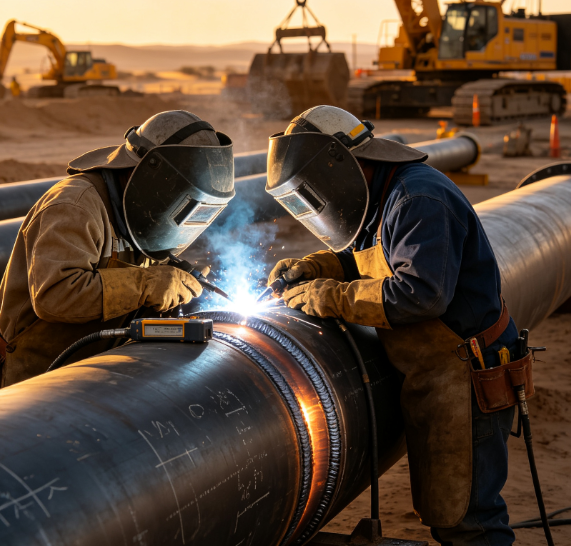
A 36-inch subsea gas pipeline failed just 14 days after startup. The cause was not corrosion, not a flaw in the pipe body—it was excessive misalignment at a girth weld. On another site, four workers assembled twelve clamp joints in an hour with a wrench; that system has now run leak-free for a decade. These two scenes point to the same question: what factors affect pipeline integrity?
For any pipeline, failure almost never occurs in the middle of a pipe section. It happens at the joint. During the 1995 Kobe earthquake, over 1,600 pipeline leaks were documented—nearly every one at a connection point. The choice of connector, made during the design phase, sets the safety baseline for decades of operation. A report published in February 2026 by the Norwegian Ocean Industry Authority (Havtil) makes this explicit: the choice of connectors in the design phase is of great importance for safety throughout the entire service life.
Table of Contents
The Essence of Welding: Making Two Pipes Into One
The Essence of Clamping: Using Structure to Lock Pressure, Elasticity to Absorb Change
Core Dimension Comparison
Selection Decision Framework
Summary
FAQ
The Essence of Welding: Making Two Pipes Into One
The fundamental logic of welding is to heat the ends of two pipes to a molten state and allow them to re-solidify as a single entity. Ideally, there is no physical interface between the weld and the parent material—metal is continuous, no seals, no gaskets, no leak path. That is why, over a 30-year design life, a properly executed weld joint can achieve a leak rate below 10⁻⁹ Pa·m³/s.
But the word “ideally” buries a significant premise: welding quality must be uncompromising. The reality on the field is that roughly two-thirds of all leaks in high-pressure pipe connections are caused by improper root penetration. Porosity, slag inclusions, and incomplete fusion—these defects are directly influenced by welder skill, environmental conditions, and on-site shielding gas quality. Joints with welding defects can lose roughly 40% of their strength, and cracks propagate through them at two to three times the normal rate. Worse, on-site weld quality is heavily dependent on welder skill, and achieving adequate shielding gas coverage at field weld joints is difficult, directly shortening pipeline service life.
This yields a critical design insight: the quality ceiling of a welded joint is extremely high, but so is the quality variance. The design must actively close that variance through nondestructive testing. Ultrasonic testing (UT) can detect subsurface cracks down to roughly 0.5 mm with an accuracy of about 98%, far exceeding the roughly 80% capability of visual inspection. In other words, welding is not unreliable—welding without inspection is unreliable.
There is another easily overlooked dimension: a welded joint is completely rigid. It cannot absorb displacement from thermal expansion, ground settlement, or seismic events. All stress concentrates at the weld and heat-affected zone. External compensators—expansion joints or pipe loops—must do the absorbing.
Applicable Standards and Certification:
ASME B31.3 (Process Piping Code) is the core specification governing design, materials, fabrication, assembly, examination, and testing of welded piping in refineries, chemical plants, and related process facilities.
ASME Section IX governs welding procedure qualification (WPS/PQR) and welder performance certification, forming the foundation of weld quality assurance.
For high-temperature, high-pressure service, pipe materials commonly reference ASTM A53/A106 (carbon steel) or ASTM A312 (stainless steel) standards.
The Essence of Clamping: Using Structure to Lock Pressure, Elasticity to Absorb Change
Clamped connections (grooved couplings) follow a completely different logic. They do not attempt to make two pipes one. They accept that the two pipes remain two independent components and use a metal housing with an elastomeric gasket to mechanically lock them together. A groove is cut into the pipe ends; the coupling housing rides on the groove; tightening the bolts compresses the gasket to form a pressure-tight seal. This is the fundamental difference from welding: because an interface exists, a seal exists; because a seal exists, aging exists.
Flexible grooved couplings can tolerate approximately 5 mm of pipe deflection and vibration, making them suitable for geologically unstable areas. The elastomeric gasket absorbs vibration and thermal expansion displacement, avoiding the stress concentration at the weld and heat-affected zone that welded structures suffer. Victaulic test data shows that three flexible couplings installed near a vibration source outperformed both double-sphere rubber connectors and stainless steel braided pump connectors in vibration attenuation. Additionally, flexible couplings allow limited angular movement, while rigid couplings provide fixing restraint comparable to flanged or welded joints—a hybrid approach already validated in multiple seismic-risk project applications.
But grooved connections have a physical ceiling. Standard working pressure is typically limited to roughly 2.5 MPa, and elevated temperatures significantly accelerate gasket aging. The grooving process inherently cuts into the pipe wall: if the remaining wall thickness is insufficient or groove tolerances are out of control, the grooved section becomes the weakest point of the entire pipe cross-section.
Historically, mechanical pipe connections have shown lower overall reliability statistics than welded joints, which is why welding has been the preferred method for subsea pipelines. However, DNV's Recommended Practice RP-F104 establishes a systematic qualification methodology that enables mechanical coupling reliability to approach that of welded joints—provided each potential failure mode is identified and a reasonable safety margin is documented through analysis and testing.
Applicable Standards and Certification:
Clamp connectors must satisfy ASME B31.3 requirements for mechanical joints, including manufacturer-certified design pressure and temperature ratings.
Fire protection system couplings must carry UL 213 / FM Approvals certification—mandatory for fire sprinkler piping worldwide.
Manufacturers typically provide joint strength calculations conforming to ASME Section VIII Div.1 pressure vessel design principles.
Pipe grooving dimensions generally reference AWWA C606 (Grooved and Shouldered Joints) standard.
Core Dimension Comparison
Dimension | Welded Connection | Clamped (Grooved) Connection |
Sealing Mechanism | Metal continuity, no interface, no leak path | Elastomeric gasket compressed to form a pressure-tight seal |
Maximum Pressure | Theoretically unlimited; in systems above 100 MPa, welding is essentially the only viable option | Typically to ~2.5 MPa; high-pressure variants to 10+ MPa |
Long-Term Leak Rate | Qualified weld: below 10⁻⁹ Pa·m³/s | Dependent on gasket material aging life; design life tied to gasket replacement interval |
Failure Modes | Incomplete fusion, porosity, slag inclusion leading to leaks; stress corrosion cracking and fatigue crack propagation | Gasket aging/swelling leading to leaks; stress concentration at groove root may cause pipe wall fracture |
Installation Speed | Slow; requires certified welders, hot work permits, post-weld NDT (UT/RT) | Fast; installable by semi-skilled labor; typical time savings ~30–50% vs. welding |
Disassembly Potential | Non-demountable; cutting required for modification or repair | Demountable; loosen bolts to replace components |
Rigidity / Flexibility | Completely rigid; external expansion joints required | Flexible couplings absorb thermal expansion and vibration; rigid couplings provide fixed restraint |
Seismic Performance | Lowest stress and smallest displacement (~24 mm); suitable for zero-tolerance facilities | Flexible couplings show larger displacement (~38 mm); effectively absorb energy within movement range |
Vibration Attenuation | Provides no vibration attenuation; stress concentrates at welds | Flexible couplings attenuate vibration; validated by NASA testing |
Cleanliness / Sanitary | Smooth internal bore, no crevices; gold standard for cleanroom/pharma | Slight gasket protrusion may affect ultra-sensitive flows |
Lifecycle Cost | High upfront installation cost (certified welders + hot work permits + NDT); high maintenance and modification costs | Moderate material cost, low installation labor, easy maintenance; balanced total cost of ownership for non-critical services |
Suitable Media | High temperature, high pressure, corrosive media, flammable/explosive fluids, ultra-pure systems | Ambient-temperature water systems, fire protection, HVAC, temporary piping, commercial/modular construction |
Data sources: Havtil 2026 connector integrity report, ASME B31.3, Victaulic engineering test literature, published industry comparison data.
Selection Decision Framework
Choosing between welding and clamping is not a question of “which is better.” It is a question of what your system can least afford to tolerate.
If the system can least tolerate leakage itself: Choose welding. High-pressure steam, hazardous chemicals, subsea pipelines—these services carry catastrophic consequences if a leak occurs. Welding eliminates the interface leak path, and the investment returns as avoided risk.
If the system can least tolerate downtime: Choose clamping. Commercial buildings, fire protection systems, temporary piping—these demand rapid installation and future reconfigurability. Clamping requires no hot work permits, no certified welders, no X-ray testing. During a maintenance shutdown, loosening bolts enables component replacement.
In seismically active zones: Use a hybrid approach. Rigid couplings on straight pipe runs provide fixing restraint; flexible couplings at critical nodes absorb displacement. Neither fully rigid nor fully flexible.
For high-temperature, high-pressure service: Welding is essentially the only option. Standard grooved couplings are typically rated to roughly 2.5 MPa, and elevated temperatures sharply accelerate gasket aging(specific values vary by material; manufacturers provide temperature-pressure curves on request). In petroleum hot-oil gathering pipelines, welding remains the dominant solution.
For cleanroom, pharmaceutical, or food-grade piping: Welding is the gold standard. The slight internal gasket protrusion in grooved couplings may affect flow characteristics in ultra-sensitive applications.
Summary
Welding and clamping represent two fundamentally different philosophies of integrity:
Welding follows the path of eliminating the interface: making two pipes into one, trading metal continuity for a zero-leak path. The price: a permanent, non-demountable joint that is highly sensitive to process quality and completely rigid.
Clamping follows the path of managing the interface: accepting that an interface exists, then using an elastic seal and a controlled structure to tame it. The price: seals that age, a ceiling on working pressure and temperature, and historical reliability statistics that lag behind welding.
Welding lets you “weld it and forget it”—provided it was welded right. Clamping lets you “fix it anytime”—provided the service stays within its physical limits.
Which you choose depends on what your system can least afford to compromise. Welding gives you the highest reliability ceiling, but demands the highest quality assurance. Clamping gives you the greatest flexibility and the lowest downtime cost, but requires you to accept seal life limits and pressure/temperature ceilings. The critical decision point is: over the full design life of the system, can site conditions and available personnel sustain a qualified welding quality assurance program? If yes, welding is usually the optimum solution. If no, the controllability and maintainability of clamping are often more realistic than the nominal reliability of welding.
Pipeline integrity is determined not by the connection method alone, but by how honestly you assess the failure modes of that joint.
FAQ
Q1: Can clamped connections be used for high-pressure pipelines?
A: Standard grooved couplings are generally suitable for systems not exceeding approximately 2.5 MPa. For higher pressures, high-pressure variants are available, but there exists an industry-recognized pressure ceiling beyond which welding or flanged connections become necessary. In systems above 100 MPa, welding remains essentially the only viable solution.
Q2: How long does a clamp gasket last?
A: Gasket life depends on operating temperature, media chemistry, and pressure cycling. Elevated temperatures significantly accelerate gasket aging. Gaskets are typically made of specific elastomers such as EPDM; they age through hardening, cracking, and compression set (thickness reduction), ultimately leading to leakage. Manufacturer maintenance manuals provide gasket replacement interval recommendations and inspection criteria.
Q3: How is field welding quality ensured?
A: Four critical elements: certified welders (qualified per ASME Section IX), qualified welding procedures (WPS/PQR), nondestructive testing (UT or RT), and traceable inspection records. Relying solely on visual inspection is insufficient to detect internal defects. For corrosive media or high-stress service, additional penetrant testing (PT) or magnetic particle testing (MT) should be included.
Q4: In earthquake zones, should I go with welding or clamping?
A: Rigid piping under seismic loading experiences severe stress concentration. If zero leakage tolerance is required (data centers, power plants), welding is the only option—it exhibits the lowest stress and most stable behavior under all conditions. If the system can accept limited displacement, grooved couplings (particularly rigid-flexible hybrid configurations) can absorb seismic displacement and vibration energy within their design range. Final selection should be supported by pipe stress analysis (e.g., AutoPIPE) and comply with ASME B31.1/B31.3 seismic design requirements.
Q5: Does grooving weaken the pipe?
A: Yes. Grooving involves cutting into the pipe wall using specialized tooling. If the groove is machined out of specification—excessive depth or insufficient remaining wall thickness—the groove root becomes the weakest section of the entire pipe. However, for grooves machined per manufacturer specifications, the strength reduction is already accounted for in the design safety factor. The key: use manufacturer-certified grooving equipment and strictly control machining parameters according to pipe diameter and wall thickness requirements.
Q6: Which connection method is better for stainless steel piping?
A: It depends on the application. Stainless steel welding requires specific welding methods and matched filler metals. In field welding, inadequate shielding gas coverage readily leads to weld oxidation and reduced corrosion resistance. For thin-walled stainless tube (e.g., food, pharma), post-weld pickling and passivation can restore corrosion resistance. For large-diameter industrial piping, welding is the mainstream choice. For building water supply, fire protection, and other non-critical services, grooved connections are more efficient and preserve the material's passive film. Press-fit (double-press) connections are also a well-established mechanical joining method for stainless steel, with built-in O-ring seals and quick, reliable installation. The choice should comprehensively consider pressure rating, operating temperature, corrosion environment, and maintenance requirements.
Technical references: ASME B31.3 Process Piping Code (welding and mechanical joint design, fabrication, and inspection requirements), ASME Section IX welding procedure and welder qualification, DNV RP-F104 mechanical pipeline coupling qualification recommended practice, Havtil 2026 pipeline connector integrity report. Vibration attenuation data sourced from third-party testing of Victaulic flexible couplings at the NASA Vibration and Acoustic Test Facility (VATF). Clamp seismic performance data sourced from published testing by ANCO Engineers Inc. and the Lehigh University ATLSS Laboratory. Leak rate orders of magnitude and pressure ceiling data sourced from publicly available industrial piping connection technology literature. Specific selection should be confirmed against manufacturer-certified data and site-specific service condition assessment.
本回答由 AI 生成,内容仅供参考,请仔细甄别。